AMEB Victoria plays a unique role in the arts education ecosystem, providing public examinations in music, speech and drama and recognising achievement for thousands of students each year. As the organisation evolved, so did the expectations of its community. Teachers were increasingly under-resourced, parents were taking on more responsibility for exam preparation and students needed clearer guidance across a growing range of instruments, syllabuses and programs.
This case study explores how we worked with AMEB Victoria to redesign their website into a practical hub for information.
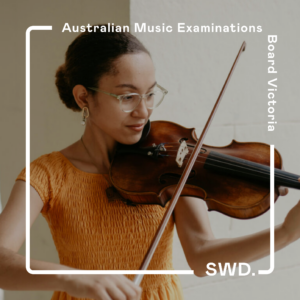
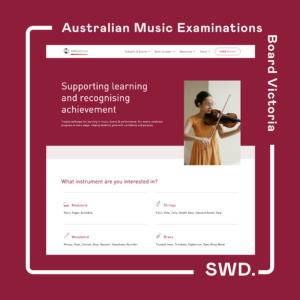
A changing relationship between teachers, parents and students
Historically, teachers were the primary conduit between AMEB Victoria and their students. Over time, however, the organisation recognised that teachers were increasingly stretched. Parents were stepping in to manage enrolments, practice schedules and exam logistics. AMEB Victoria needed its website to respond to this shift and provide a more direct, self-service experience for families.
The growing role of parents in exam preparation
The numbers tell part of the story. Today, over 3,000 parents directly enrol their children in examinations, compared with approximately 1,500 teachers who enrol students. Across the year, AMEB Victoria supports more than 25,000 students, with multiple practical exam sessions scheduled, including a couple of major sessions supported by smaller sessions in between.
In this context, parents are no longer passive observers. They are actively involved in ensuring their children rehearse the correct pieces, understand technical requirements and are ready for exam day. AMEB Victoria needed a digital experience that recognised this reality and gave every stakeholder a clear pathway to the information they needed, when they needed it.
From examination board to information hub
The previous website could not keep up with these expectations. Content had grown organically over time, resulting in duplication, inconsistent labelling and many instances where users struggled to find the right information at the right moment. The organisation wanted to reposition the website as a practical information hub that could serve parents, students and teachers equally well.
Our broader work in non-profit digital services has shown that when specialist organisations face rising demand, the digital front door becomes critical. For AMEB Victoria, that meant a structure that mirrored their real-world processes and a user experience that supported independent decision making.
Project objectives
Key goals for the new website
Together with AMEB Victoria, we defined a set of practical goals to guide the redesign:
- Make it easier for parents, students and teachers to find accurate information about exams, syllabuses and enrolment requirements.
- Reduce content duplication and present information in a clearer, more logical structure.
- Support different user journeys, from first-time enrolments to advanced repeat candidates.
- Provide a sustainable content management approach that could be maintained by a small internal team.
- Reflect the organisation’s position as a trusted, contemporary authority in music, speech and drama.
These goals informed every decision, from information architecture and navigation labels through to layout, visual design and technical implementation. They also aligned closely with our approach to non-profit website design, where clarity and usability must be balanced with budget and internal capacity.
Information architecture: turning complexity into clarity
A more thoughtful structure for specialised information
The old website had accumulated layers of content over many years. Important pages could be reached in several different ways, and similar information often appeared in multiple places. This increased the likelihood of inconsistencies and made it difficult for users to feel confident they had found the most current guidance.
Our first step was to map every content type and user journey, then reorganise the website around the real questions people were asking.
- Subjects and instruments grouped into intuitive categories that align with how musicians think about their practice.
- Clear pathways for booking exams, understanding requirements and preparing for exam day.
- Dedicated areas for resources, downloads and teacher support, reducing overlap and duplication.
- Strong cross-linking between related sections, so users can move naturally from exploration to action.
Segment-based layout for easy scanning
On key pages, we introduced a segment-based layout that breaks information into clearly defined blocks. Each segment focuses on a single theme, such as instruments, subjects, special programs or enrolment help. This approach makes the content easier to scan and helps users quickly identify the pathway that matches their needs.
For AMEB Victoria’s team, this structure also supports the ongoing management of content. Segments can be reordered, updated or expanded without disrupting the integrity of the overall layout. This was an important consideration for a not-for-profit that needs to manage content efficiently without developer involvement on every change.
Many of these ideas draw from our experience in website design for charities where dense, policy-heavy information must still feel inviting and approachable for families.
“What’s in My Exam?” – giving every user a clear roadmap
Designing a tool for real-world exam planning
One of the standout features of the new website is the “What’s in My Exam?” tool. AMEB Victoria needed a way for parents, students and teachers to quickly understand exam requirements without having to decipher long documents or cross-reference multiple pages.
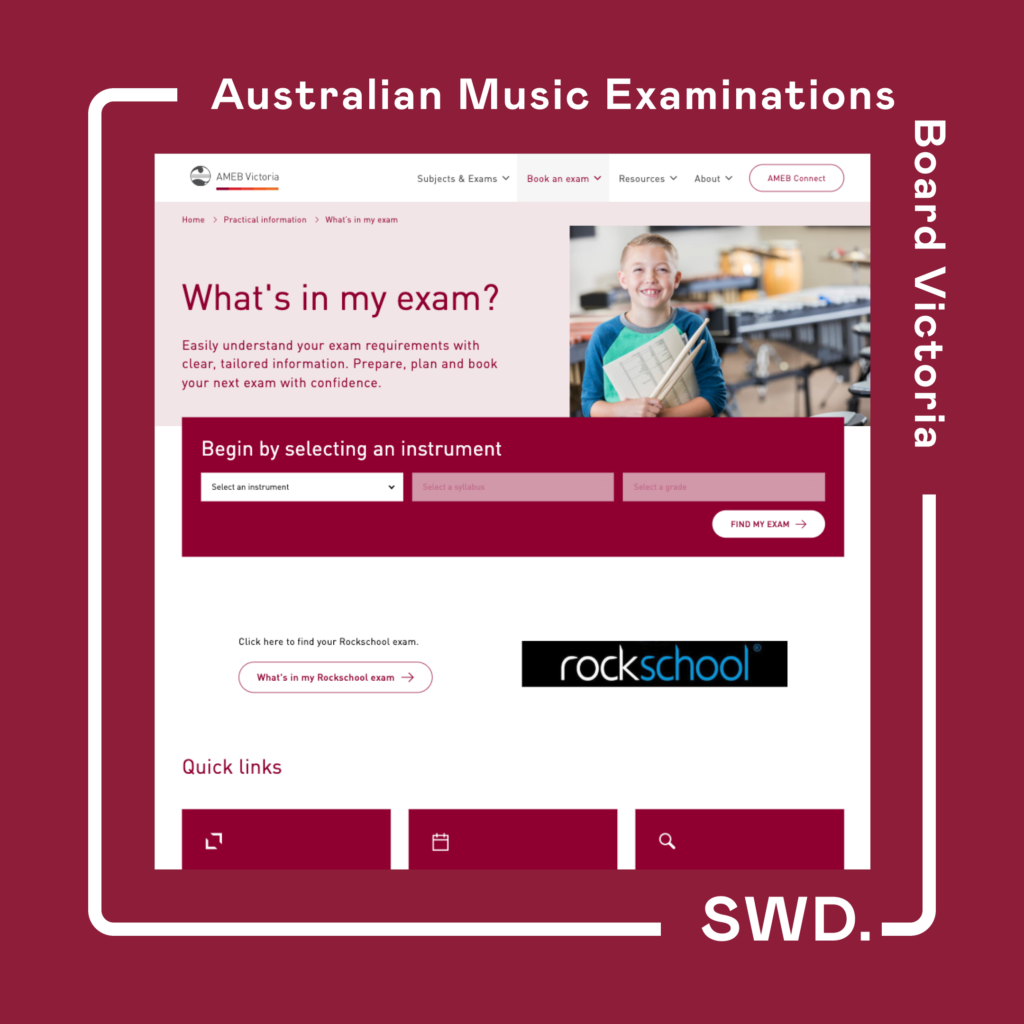
The tool guides users through a simple but powerful sequence:
- Start by selecting an instrument.
- Choose the relevant syllabus for that instrument.
- Select the grade associated with the upcoming exam.
Once these steps are complete, the tool assembles a concise, tailored view of the exam requirements. It presents the subject code – a unique identifier for that specific combination of instrument, syllabus and grade – along with the technical work, pieces and any additional descriptors candidates need to know.
Key features of the “What’s in My Exam?” experience
- Clear explanation of technical work, repertoire expectations and supporting materials.
- Options to email or print the requirements, supporting different teaching and practice styles.
- A structure that can grow over time as syllabuses evolve and new programs are introduced.
This tool embodies the project’s goal of making exam preparation more transparent. Rather than leaving parents to interpret large manuals or rely solely on teachers, they can now independently confirm what is required and help their children prepare with confidence.
Behind the scenes, this functionality is supported by careful non-profit website development work, ensuring the tool is efficient, maintainable and able to respond as AMEB Victoria’s offerings change.
Visual direction: contemporary, confident and warm
Balancing authority with creativity
AMEB Victoria needed a visual identity that reflected its status as a trusted examination board while still feeling connected to the creative world of music and performance. The new website embraces a contemporary, professional aesthetic, with a confident tone that reassures families and educators.
Generous white space helps complex information feel digestible. Section headings, cards and call-to-action areas are carefully spaced so that users can move through content without feeling overwhelmed. At the same time, the colour palette and typography choices introduce warmth and personality that align with the arts and creative education context.
Photography in a niche subject area
Imagery was another important consideration. Because AMEB Victoria operates in a specialised domain, photography needed to be accurate in terms of instruments, performance contexts and relevance to the Australian market. Finding the right imagery was challenging, particularly when generic stock libraries did not always align with local instruments, age groups or exam settings.
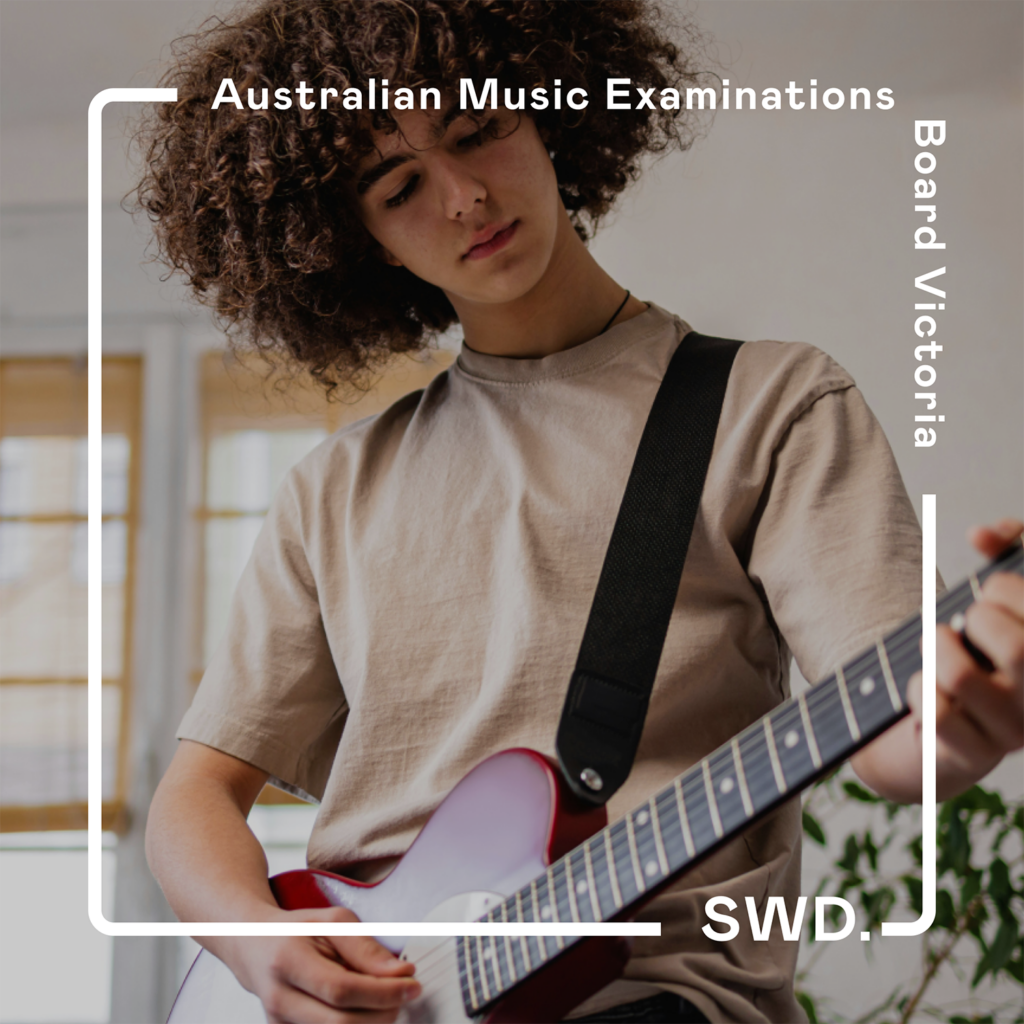
At the time of the project, we had not yet implemented the Gemini-based AI workflow described in our separate piece on how AI can help rethink website imagery. This meant we relied heavily on carefully curated photography to maintain authenticity.
Technology, integrations and sustainability
Subscribe form and Campaign Monitor integration
Beyond static content, AMEB Victoria also needed a simple, reliable way to grow and manage its email audience. To support this, we implemented a subscribe form that appears at the bottom of almost every page. When a user submits their name and email address, they are automatically added to AMEB Victoria’s newsletter database.
The subscription workflow is powered by a Campaign Monitor API integration, supported by additional safeguards to ensure data is never lost.
Redundancy and administrative visibility
- Contact details are pushed to Campaign Monitor via the API for automated newsletter management.
- Subscriber information is also stored in a database, providing a backup record for internal reporting.
- Administrators receive email notifications when new subscribers join, helping the team stay aware of audience growth.
This combination of automation and redundancy gives AMEB Victoria confidence in their subscriber data while keeping the workflow simple for staff. It is a good example of how technical development for education and arts organisations can quietly support long-term engagement without adding extra complexity.
CMS handover for a busy not-for-profit
As a charity and not-for-profit, AMEB Victoria needed more than a visually polished front end. They needed a content management system that could be managed by an internal team whose strengths lie in administration and program delivery, not development.
By the time we handed over the website, AMEB Victoria’s team were able to confidently manage day-to-day updates, publish news and refine content as their programs evolve. This approach reflects our philosophy across support for non-profit organisations: build something sustainable, not just something that looks good on launch day.
Delivering quality within not-for-profit realities
AMEB Victoria operates within the financial constraints common to charities and not-for-profits. A key measure of success for this project was our ability to deliver a high quality, specialised digital experience while respecting those boundaries. By focusing on information architecture, practical tools like “What’s in My Exam?” and a maintainable CMS, we ensured the investment continues to deliver value year after year.
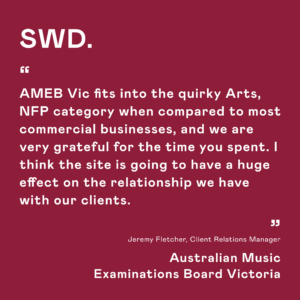
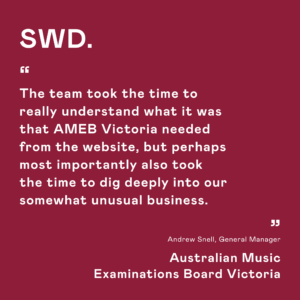
The feedback from the client and board has been very positive, particularly around how independent the new website feels. Parents and students can now navigate more autonomously, find the information they need and take the next step in their musical or performance journey without unnecessary friction.
Looking ahead
Supporting more organisations like AMEB Victoria
The AMEB Victoria project illustrates what can be achieved when strategy, design and development are aligned around real user needs. For specialist education and arts organisations, the challenge is rarely just about aesthetics. It is about creating an environment where complex information becomes understandable and where staff can continue to manage that environment over time.
Many of the principles used here – segment-based layouts, practical tools, sustainable CMS structures and thoughtful integrations – are the same foundations we apply in non-profit website development more broadly. Combined with our experience in non-profit website design, they help organisations like AMEB Victoria offer families a digital experience that is as considered as the learning journeys they support.